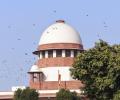
The Supreme Court on Thursday declined to overturn the Patna high court's interim order suspending the Bihar government's caste survey.

A five-judge Constitution bench headed by Justice Sanjay Kishan Kaul, in a unanimous verdict, ruled that its 2014 verdict, which had struck down a provision of the Delhi Special Police Establishment (DSPE) Act, 1946 providing immunity to such officers in graft cases, will have retrospective effect.
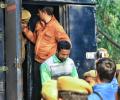
The bench, which refused to stay the high court verdict, imposed certain conditions and directed that the four people, who were acquitted, be released unless wanted in any other case.

In another first, the venue of the ceremony was shifted to the newly-built auditorium instead of the CJI's courtroom, the traditional place for such a ceremony.

The Supreme Court said on Friday the extension of time granted to probe agencies to file charge sheets in criminal cases is not an "empty formality" because it deprives the accused of their "indefeasible right" to seek default bail due to non-completion of investigation during the stipulated period.
Justice SK Kaul was among those seated on the dais with Chief Justice DY Chandrachud, when the president narrated her experience of meeting several undertrial prisoners as an MLA in her native Odisha and later as the governor of Jharkhand.
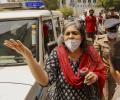
The Supreme Court on Wednesday questioned the CBI and the Gujarat government as to why they want to send social activist Teesta Setalvad and her husband Javed Anand back in jail after they have been out for over seven years on anticipatory bail.

The government told the high court of its decision to file a special leave petition in the Supreme Court to appeal against the acquittal.

'Instead of doing ground work they are sitting and monitoring the drought through Mantralaya and trying to solve the problem with Aamir Khan.'

A bench headed by Justice AM Khanwilkar was hearing the pleas, including those challenging the orders blacklisting several citizens of 35 countries from travelling to India for 10 years for alleged involvement in Tablighi Jamaat activities.

It is for the first time in the history of the apex court that nine judges took oath of office at one go.

The Supreme Court on Friday said when the public interest is so clearly articulated and is an urgent and pressing exigency, private interests must give way to the extent required.

FIRS were earlier registered in connection with the three-day Dharam Sansad that was held in Haridwar last December where hate speeches were made targeting members of a community.

Posing searching questions, the court also directed the police to file a 'better affidavit' after which Additional Solicitor General (ASG) K M Nataraj, appearing for the Delhi Police, said they will have a 're-look' of the matter and file a fresh affidavit.

Ganesh Chaturthi celebrations will not be held at Bengaluru's Idgah Maidan, the Supreme Court said on Tuesday while refusing to grant permission for the function and ordered status quo on the plot by both parties. Noting that no such function as Ganesh Chaturthi was organised at Idgah Maidan for the past 200 years, the top court asked the parties to approach the Karnataka high court for the resolution of the dispute.
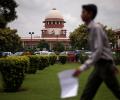
The new judges of the top court include Justice B V Nagarathna, who will be in line to be the first woman Chief Justice of India (CJI) in September 2027, Justice Bela M Trivedi, Justice Hima Kohli, Justice C T Ravikumar, Justice M M Sundresh, and senior advocate and former Additional Solicitor General P S Narasimha.

Prior to the swearing-in of Justices Hima Kohli, Nagarathna and Bela M Trivedi, only eight women judges, including sitting judge Justice Indira Banerjee, were appointed as apex court judges.
